Popular publication
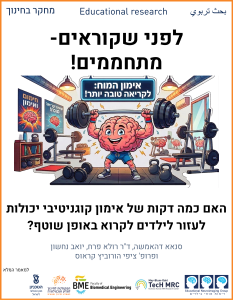
Before Reading, Warm Up the Brain!

Can a Few Minutes of Cognitive Training Help Children Read More Fluently in the Classroom?

Authors: Sanaa Dahamshy, Rola Farah, Yoav Nahshon and Tzipi Horowitz-Kraus

We all know that warming up before physical activity prepares the body for exertion, but can we also “warm up” the brain before learning? In our study, we followed children from first through third grade to examine whether a brief cognitive warm-up, consisting of games that engage attention, working memory, cognitive flexibility, and inhibitory control in first grade, and again before a computerized reading intervention in third grade, could improve their reading abilities. Over the course of eight weeks, the children participated in training sessions three times a week, and their reading skills and executive functions were assessed before and after the intervention.

We found that children’s reading fluency improved significantly following the training program. Moreover, children who began the intervention with weaker executive functioning skills benefited the most from the program. Our findings highlight the important role that abilities such as attention, working memory, and cognitive flexibility play in the development of reading fluency, and suggest that targeted executive function activities before reading may help prepare the brain for learning and make the learning process more effective. This approach may contribute to the development of more personalized educational programs, particularly for children who experience difficulties in learning to read.

Link to the full article: https://www.mdpi.com/2227-7102/16/6/957


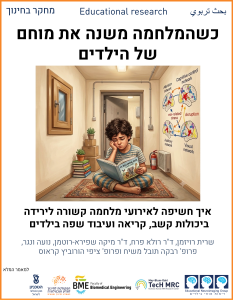
When War Changes Children’s Brains

How Is Exposure to War-Related Events Associated with Difficulties in Attention, Reading, and Language Processing?

Authors: Sarit Roizman, Rola Farah, Noah Wenger, Mika Shapira Rootman, Rivka Tuval-Mashiach & Tzipi Horowitz-Kraus

We all know that war affects children’s emotions and behaviour, but does exposure to war-related events also influence how the brain functions? To address this question, we compared children aged 5-13 who were assessed before the war with children who were assessed during the war. They completed tasks measuring attention, language, and reading abilities, and we asked about their experiences during the war period. Using advanced brain imaging techniques, we also examined how different regions of the brain “communicate” with one another.

We found that greater exposure to war-related experiences—such as missile alerts, disruptions to daily routines, or feelings of insecurity, was associated with poorer performance on attention, reading, and language tasks. At the same time, we observed changes in communication patterns between different brain regions. Our findings remind us that the effects of war do not end when the sirens stop. They may continue to influence children’s learning, concentration, and overall development. We hope this research will help identify children who need additional support and contribute to the development of interventions that can help them regain an optimal developmental and learning trajectory.

Link to the full article: https://www.nature.com/articles/s41598-026-56279-x


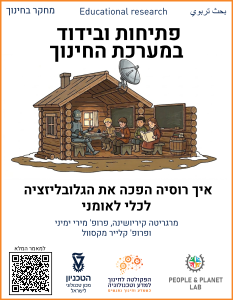
Openness and Isolation in Education

Authors: Margarita Kiryushina, Miri Yemini, Claire Maxwell

How does a country go from copying American education models to banning international organizations from its schools? We studied it using the case of Russia. Our research team analyzed policy documents, public statements, and expert interviews spanning 1992 to 2025 to trace how Russia’s relationship with the international education community changed over time. We show how Russia moved through four distinct phases: from eagerly borrowing ideas and funding from the World Bank and OECD in the chaotic 1990s, to positioning itself as a global education leader in the 2010s, to declaring “sovereign education” and cutting ties with Western frameworks after 2022. Using this case, we show how the same global tools that once helped Russia modernize its schools were later repurposed to serve nationalist goals.

Hungary, Turkey, and other countries are showing similar patterns of opening up to global education standards, then pulling back as politics shift. Understanding how and why this happens is the first step to predicting it. This research gives policymakers, international organizations, and educators a practical map: what are the warning signs? What can international partners do to maintain educational ties even when political relations deteriorate? Does ideological education necessarily mean abandoning economic logic, or can a country weaponize global tools for nationalist ends?

Link to the full article: https://journals.sagepub.com/doi/10.1177/14749041251393354


؟